The robotics industry has entered a new era of hardware maturity. Humanoids, mobile manipulators, industrial arms, aerial drones and autonomous platforms are shipping from an ever expanding ecosystem of OEMs. Form factors are diversifying, foundation models are improving and the pace of new entrants continues to accelerate.
Despite this progress, the path from working prototype to operationally skilled robot remains one of the most significant challenges in the industry. The central impediment to that goal is not a lack of capable AI — it is fragmentation. Teams must integrate perception models, control policies, simulation environments, data pipelines, and fine-tuning infrastructure across toolchains that were never designed to work together. That effort often has to be repeated for every new robot, environment, or task.
“Today, deploying a robot means stitching together numerous systems that were never designed to work together. To be truly useful, robots need a unified intelligence infrastructure."
–––
Sai Vemprala, CTO
The need for a unified intelligence grid
To move robots from proof of concept to production, the robotics industry needs a unified, adaptable infrastructure across hardware platforms, software frameworks, communication protocols, and programming paradigms. An intelligence grid is the connective infrastructure between cloud-scale AI and the physical machines that need it — designed to make robotic intelligence composable, accessible, and continuously improving.
The most useful analogy is the electrical grid. The electrical grid did not transform energy by building a better power plant. It created the networked infrastructure that made electricity available everywhere, on demand, to anyone who needed it. GRID applies that same principle to robotic intelligence: a shared, scalable layer that any robot, model, and workflow can plug into.
The adoption of automation is essential across industries; however, organizations will be severely limited if every robot requires a bespoke intelligence stack built from the ground up. The demand signal from operators is equally clear: Warehouses, factories, logistics networks, and field operations are prepared to deploy robots at scale. They require intelligence that is accessible, operational and enterprise-grade — not a research undertaking.
Every robot becomes more capable on GRID
GRID generalizes robotic intelligence -
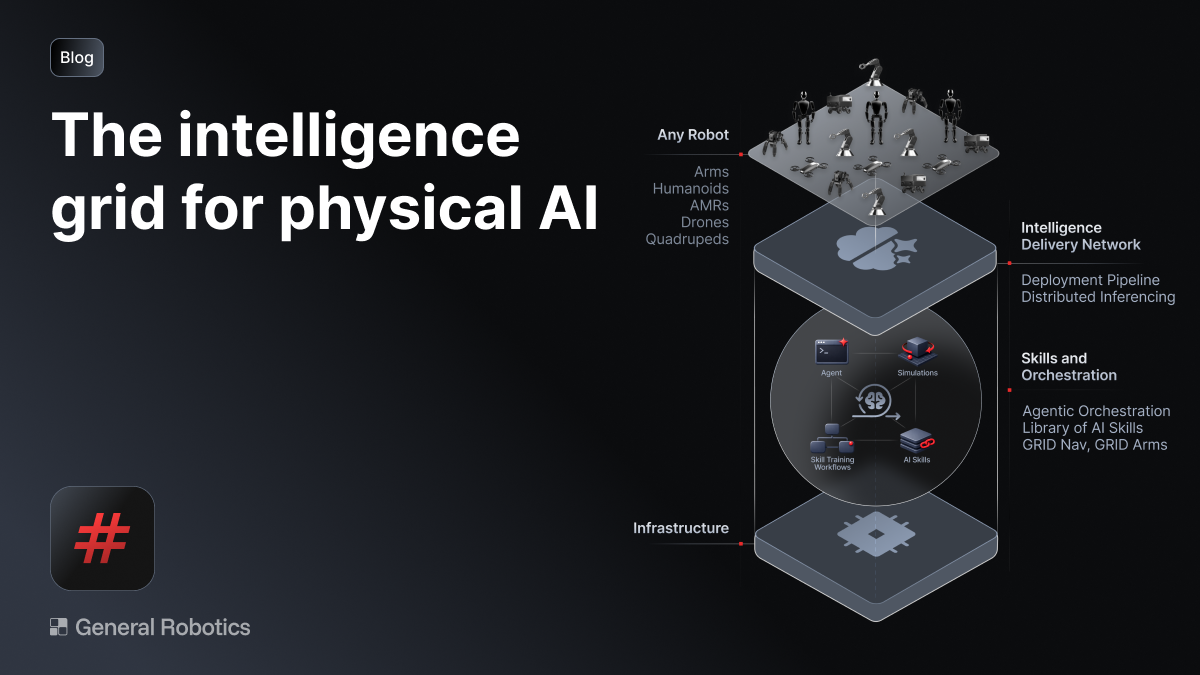
We unify how intelligence is delivered to robots, how they understand and share knowledge about the world and how they are programmed and updated. Through our proprietary Robot Priming process, Intelligence Delivery Network and Skills Orchestration, GRID becomes the fastest path to intelligent robots.
- Robot Priming. GRID translates the physical and interface specifications from any OEM into a single universalization layer. Robots onboard fast and speak the same language regardless of manufacturer, form factor, or generation. GRID can be integrated with hardware platforms as they ship, treating device compatibility as a first-class design principle.
- Intelligence Delivery Network. GRID delivers real-time intelligence to physical AI through a distributed, cloud-native inference architecture. It elastically serves models to robots in the field while maintaining production-grade links, achieving 100Hz+ control and 30fps+ image transport frequency over cloud. The result is scalable, repeatable fleet rollouts and continuous updates without requiring teams to provision, optimize, or maintain their own inference infrastructure.
- Skills and Orchestration. GRID enables operators and autonomous agents to compose skills and define workflows through natural language or code. It is agent-first for operators, and API-first for developers. A model-agnostic agentic orchestration layer composes and delivers diverse skills as endpoints, allowing general-purpose models and task-specific systems to run side-by-side. As models improve and intelligence evolves, robots connected to GRID gain new capabilities immediately, without reengineering the stack.

Agents monitor and analyze task performance of various skills and capabilities deployed on robots. That assessment then enables an agentic orchestration layer to update, fine-tune and deploy new skills and capabilities to improve robot performance across the fleet.
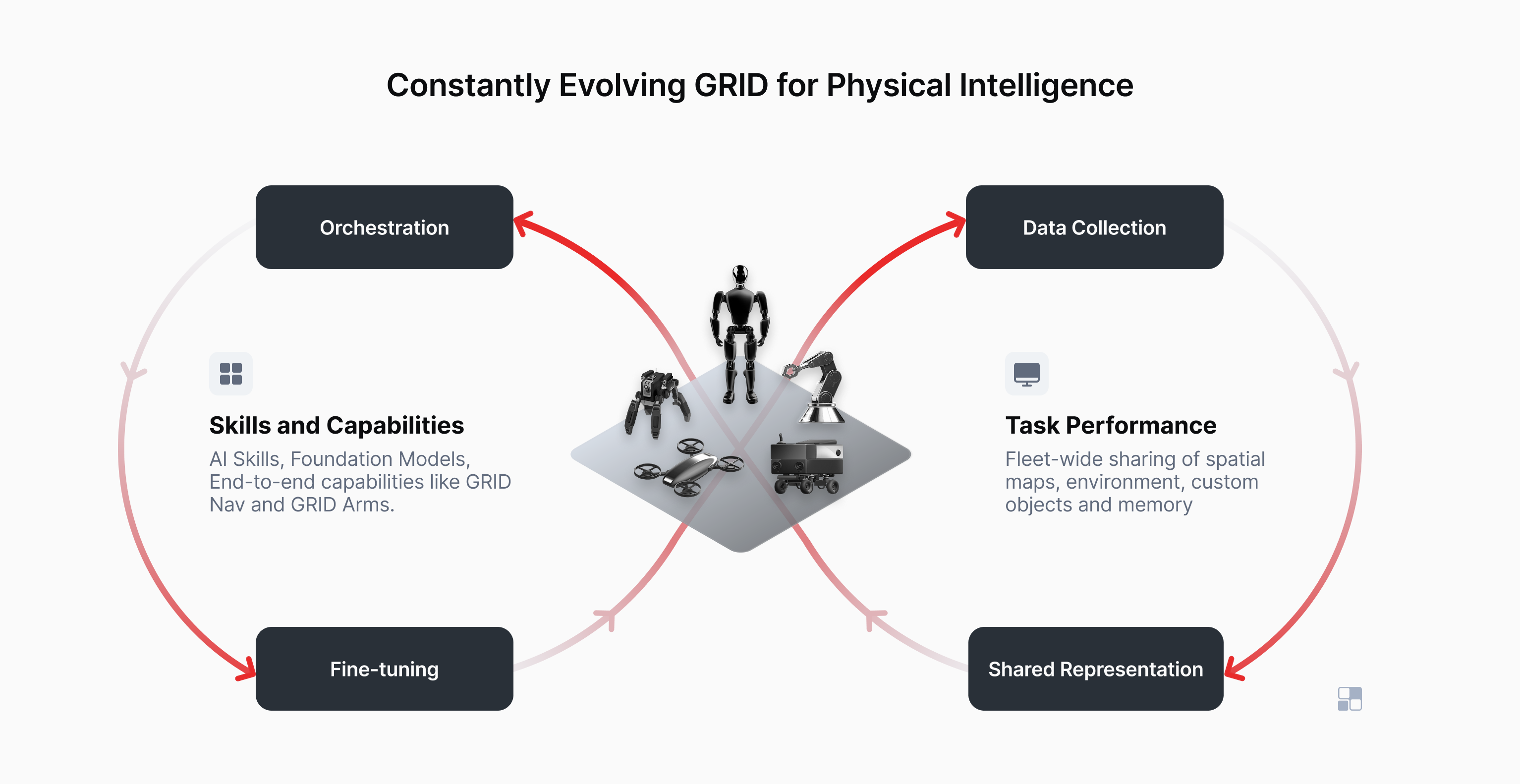
Every skill on the platform extends automatically to robots on GRID. Today GRID supports more than 40 robots and continues to expand across leading OEMS including Fanuc, Flexiv, Galaxea, Ghost, Psyonic, Universal Robots and others. As new OEMs connect to GRID, the ecosystem strengthens for all participants. Each platform advancement is shared across connected robots from AI models to inferencing.
“With fewer than one in twenty ML engineers working on robotics, the next era of automation requires a new paradigm that makes intelligence universal and more accessible”
–––
Ashish Kapoor, CEO
GRID unlocks Physical AI in the enterprise
Today’s AI and robotics talent pool is severely constrained. GRID broadens access to robotic intelligence beyond specialized developers, enabling enterprise operators to build, deploy, and evolve intelligent robotic systems without deep AI or robotics expertise.
Through GRID, enterprises are leveraging state‑of‑the‑art AI from leading model providers, including NVIDIA, Physical Intelligence, Meta and others. GRID abstracts the complexity of integration, orchestration, and deployment, allowing organizations to move from experimentation to production, at scale. As a result, enterprises can move beyond simply consuming technology to becoming active producers of robotic intelligence for competitive advantage.
Enterprise adoption requires more than capability; it requires control. With GRID, organizations within the Singapore government and Ghost Robotics are developing sovereign AI capabilities tailored to their specific operational requirements, while retaining full ownership of their data, models, and skills. Free from lock‑in to any OEM, model provider, or deployment architecture, all assets remain under organizational control, forming the foundation of an end‑to‑end robotics strategy they govern.
To accelerate enterprise time-to-value, we are partnering with leading professional service providers and R&D organizations. This includes our strategic partnership with Accenture, which is building on GRID to help manufacturers, logistics companies and other asset-intensive industries advance autonomous operations with physical AI. As a selected member of Microsoft for Startups Pegasus Program, we are collaborating to bring GRID to Microsoft’s enterprise network. The goal is to deliver an enterprise-grade robotics intelligence and orchestration layer that allows these organizations to rapidly deploy robots safely, efficiently, and at scale.
In partnership Mcity at the University of Michigan and other research institutions, we are enabling the frontier of cloud-first AI and robotics development. Skills developed by universities on GRID can be easily served to any enterprise, research partner or robot through the central intelligence grid. The next generation of roboticists are being trained on GRID today.
A bet on the field
Physical AI spans perception, manipulation, locomotion, planning, and simulation — a space too broad and too varied for any one architecture to address comprehensively.
Continued advances will come from many directions: foundation models, modular arc, sim-to-real transfer, task-specific policies, and techniques that have not yet been developed.
GRID is designed to integrate all of them as they emerge.
Any robot. Any AI skill. Any task. One intelligent grid.
The robots are here. The models are here. What’s missing is the infrastructure to connect them.
With GRID, we are delivering it.